 Insights
When comparing a google ads agency vs in house marketing roi, an agency typically delivers a higher net return for businesses spending under $30,000 per month in ad spend due to lower overhead and built-in technical expertise. In-house marketing teams provide deeper brand intimacy, but carry heavy fixed payroll, software licenses, and operational ramp-up delays that suppress initial profitability. The winning model ultimately hinges on your monthly ad budget, operational maturity, and technical data infrastructure.
The True Financial Equation: Upfront Costs vs Hidden Overhead
Calculating true return on investment requires looking far beyond an agency's monthly retainer or a media buyer's base salary. Most leadership teams severely underestimate the hidden operational load required to sustain high-performing paid search campaigns internally.
The Fully Loaded Cost of an In-House Paid Search Hire
- Direct Compensation: A qualified paid search manager commands a base salary between $75,000 and $110,000 annually, not including health benefits, payroll taxes, and performance bonuses.
- Software Stack: Enterprise bid management platforms, competitive intelligence tools, and landing page builders easily add $500 to $1,500 every month in software overhead.
- Recruitment and Onboarding: Finding qualified search talent takes an average of 45 to 60 days, during which your campaigns either stall or burn budget unmanaged.
By contrast, an external agency bundles these tools, team redundancies, and strategic management into a predictable monthly fee or a performance percentage. For companies wanting to avoid manual spreadsheets and fractured toolsets, understanding your baseline operational expenses is the first step toward safeguarding margins.
Technical Capabilities and Data Infrastructure: The Real ROI Driver
Modern paid search is no longer just about selecting keywords and writing compelling ad copy. Winning accounts rely on server-side tracking, algorithmic bid tuning, and clean customer data pipelines that feed first-party signals directly into Google's Smart Bidding engine.
An internal specialist often struggles to manage end-to-end technical tasks alone. If your tracking breaks or your CRM fails to sync offline conversion data, ad spend gets wasted on low-value clicks that never convert into paying customers.
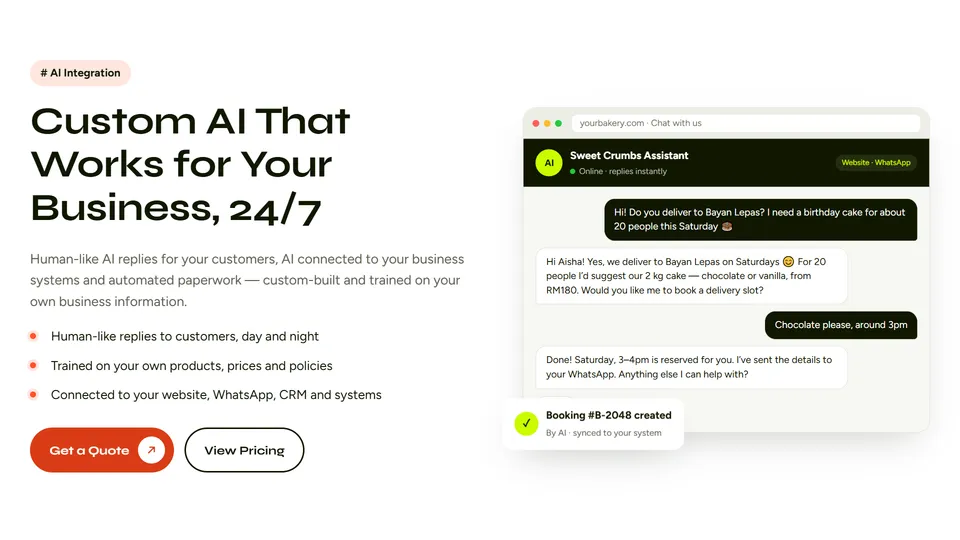
Working with an agency that possesses deep technical development experience bridges this gap immediately. Sophisticated agencies engineer custom tracking pipelines, connect APIs to back-office systems, and deploy custom AI integrations that automatically route high-intent leads into your sales pipeline without manual data entry.
Related: custom AI integrations

Conversion Rate Optimization: Why Landing Pages Dictate Your Returns
Driving qualified paid traffic is only half the battle when evaluating your bottom-line return. A media buyer can deliver exceptionally low cost-per-click rates, but if your landing page fails to convert, your campaign returns quickly plummet into negative territory.
- Speed and User Experience: A two-second delay in page load time can slice conversion rates by over 20%, driving up customer acquisition costs instantly.
- Responsive Technical Architecture: Modern buyers switch devices fluidly, demanding rapid, intuitive layouts powered by responsive web development designed specifically for direct response.
- Frictionless Capture: Disjointed forms, broken validation scripts, and confusing user journeys quietly bleed your advertising budget every single day.
An in-house media buyer rarely possesses the UI/UX design and frontend coding chops required to overhaul landing pages on the fly. Agencies with full-stack capabilities build, test, and refine high-converting sales assets continuously, creating a measurable lift in your google ads agency vs in house marketing roi evaluation.
Related: responsive web development

Strategic Agility: Channel Diversification and Knowledge Transfer
Solo in-house marketers frequently develop blind spots because they operate within a single account day after day. When Google rolls out significant algorithm adjustments or changes matching behavior, an internal team must learn through expensive trial and error on your dime.
Agencies manage hundreds of thousands of dollars across varied industries each month. This macro perspective enables them to spot market shifts, test emergent beta features, and deploy winning strategies before your competitors even recognize the change.
Moreover, top-tier agencies understand how paid search fits alongside your wider footprint. They integrate search intent with your broader online presence, aligning pay-per-click campaigns with your broader digital marketing strategy to capture prospects across every stage of the buying journey.
Making the Decision: When to Hire Internally vs Partner Externally
Deciding between these two paths comes down to simple math, internal bandwidth, and the complexity of your current sales infrastructure. Neither option is universally superior; each serves distinct stages of operational scale.
When In-House Marketing Makes Financial Sense
- Massive Monthly Ad Budgets: If your monthly media spend consistently tops $50,000 to $100,000, paying a single salary becomes more cost-effective than a percentage-of-spend agency tier.
- Hyper-Niche Subject Expertise: Businesses requiring daily, highly specialized technical dialogue with prospects often benefit from having a dedicated team member embedded on-site.
When an Agency Delivers Superior Bottom-Line ROI
- Budgets Under $30,000 Monthly: Small-to-midsize businesses capture immediate efficiency by accessing an entire team of copywriters, developers, and strategists for less than the cost of one senior employee.
- Broken Operational Systems: If you are struggling with fragmented lead management or outdated web funnels, an integrated partner resolves both the traffic and the backend bottlenecks together.
If you are ready to stop burning advertising dollars on disjointed systems and demand clearer accountability, explore our transparent pricing packages to see how Webbily helps you build streamlined growth engines that maximize real revenue.
Related: pricing packages
Frequently Asked Questions
What ad spend threshold justifies hiring an in-house Google Ads manager?
Most companies need at least $30,000 to $50,000 in monthly ad spend to justify the salary, benefits, and tool costs of a full-time in-house specialist over an agency retainer.
How does agency pricing compare to an in-house marketer's total salary?
A standard agency fee typically ranges from $1,500 to $5,000 monthly (or 10% to 20% of ad spend), whereas an in-house marketer costs $8,000 to $12,000 per month when factoring in salary, taxes, benefits, and software subscriptions.
Can a hybrid model of agency and in-house marketing work effectively?
Yes, many midsize businesses employ an internal marketing coordinator who handles brand messaging while partnering with an agency to execute technical bidding, automation, conversion optimization, and analytics.
How quickly does an agency deliver measurable Google Ads ROI compared to in-house hires?
Agencies usually drive measurable improvements within 30 to 60 days because they have established workflows and tools, while recruiting, onboarding, and training an in-house hire often takes 3 to 6 months before showing positive ROI.
Why do landing page design and web development directly affect Google Ads ROI?
Google Ads uses landing page relevance and user experience to calculate Quality Score, which directly determines your cost per click; better pages lower acquisition costs and convert more visitors into revenue.
Learn more at webbily.com.